How AI Data Licensing Works: What 43 Licenses Say
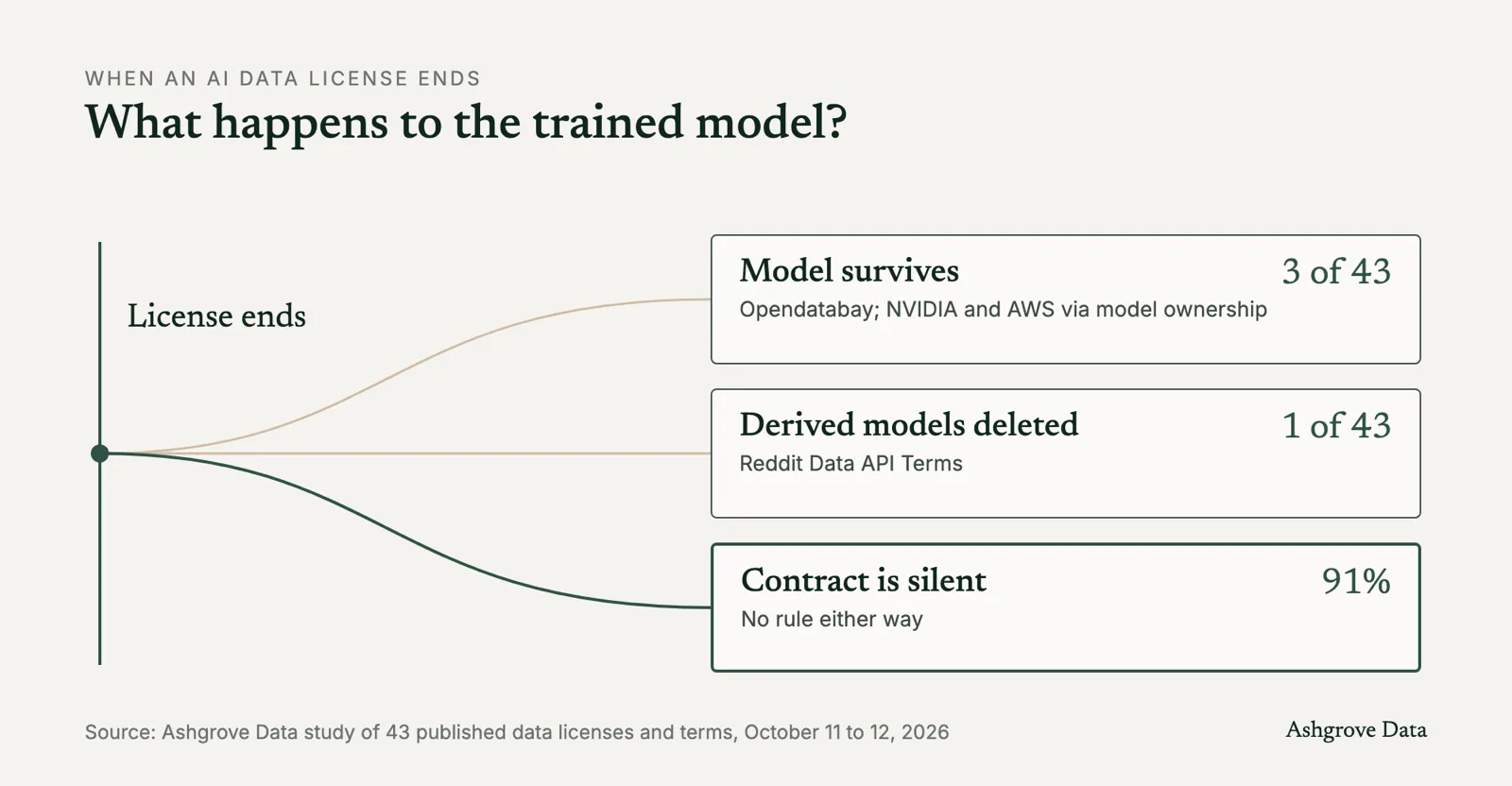
AI data licensing is a contract where the data owner keeps ownership and gives an AI developer limited rights to use a dataset, such as training, fine-tuning or evaluation, for a fee. Of the 43 published licenses we studied, 91% never address what happens to trained models.

Company records are now licensed to AI labs: Slack threads, tickets, docs and CRM history. Whether a buyer can use your data forever comes down to the license more than the price. Below: how a deal runs, what real licenses say and what to negotiate. Ashgrove Data is a broker that negotiates these terms; what follows is general information, not legal advice.
What is AI data licensing?
AI data licensing means the owner keeps ownership while a contract gives an AI developer use of the dataset for named purposes. A sale or assignment is different: ownership changes hands (Revision Legal). Because most data is facts, copyright protection runs thin, so the contract terms carry most of the weight (Kilpatrick Townsend).
| Arrangement | Who owns the data after | Can you license it again? |
|---|---|---|
| Non-exclusive license | You | Yes, to other buyers |
| Exclusive license | You | Not in the licensed field and term |
| Sale (assignment) | The buyer | No |
| Platform or API access | The platform | Platform terms decide |
One legal question comes first: can you license the dataset at all? We cover that in is selling company data legal.
Why are AI labs licensing private company data?
Public text is running out, so labs now chase records of how real work actually gets done. In June 2024, Epoch AI put the pool of public human-generated text at roughly 300 trillion tokens and warned it could be fully consumed between 2026 and 2032 if current trends hold (Epoch AI).
Reinforcement learning environments are in demand too: simulated workplaces where AI agents practice multi-step tasks (TechCrunch). One environment could bundle an IT ticket, the chat thread around it and the code fix (Fortune). For buyers and price tags, see how to sell company data to AI labs.
What do AI labs do with licensed data?
Labs put licensed data to five distinct uses, and the grant has to address each one in its own terms.
| Use | What happens to your data | Words to look for |
|---|---|---|
| Training | Shapes a model's weights | "train", "machine learning", "model development" |
| Fine-tuning | Adapts an existing model to a task | "fine-tune" |
| RL environments | Rebuilt as a simulated workplace for agents | "environments", "simulation" |
| Evaluation | Tests models, often without training on it | "evaluate", "benchmark" |
| Retrieval (RAG) | Looked up at answer time | "retrieval", "grounding" |
Among the documents we read, training shows up in 47%, evaluation in 9%, fine-tuning in 7% and retrieval in 2%. Fuzzy grant wording sparks disputes: Fastcase v. Alexi turned on what "internal research purposes" allowed (Proskauer).
What do published AI data licenses actually say? We read 43
The AI questions that matter most get no answer in most published data licenses: 91% never address trained models, and just 6 of 43 name a deletion deadline.
How we did it. Our sample covers 43 documents from 29 organizations, captured as they appeared on 11 and 12 October 2026: 9 bilateral agreements and templates (including NVIDIA's model-training data agreement and the Defined.ai license), 11 marketplace terms (AWS, Snowflake, Databricks, Datarade, Opendatabay, Protege), 13 platform and data-API terms (Reddit, X, Slack and others), 4 contributor programs and 6 standard dataset licenses. Each document was scored against 21 points, every score backed by a verbatim quote, and a document that said nothing was recorded as silent. What labs negotiate in private may differ from these published defaults.
What we found:
- Fewer than half mention AI at all. AI or machine-learning training comes up in 47%, while 16% restrict or prohibit it. X forbids using its content to "fine-tune or train a foundation or frontier model" (X).
- Trained models get ignored. A mere 4 of 43 say anything about them. 3 of 43 allow models to outlive the license; 1 of 43, Reddit, obliges the licensee to delete "any data or models" derived from its API (Reddit).
- Deletion rules are inconsistent. 37% make the licensee delete the data once the license ends. Timelines stretch from immediately (Reddit, YouTube, Discord) up to 90 days (AWS).
- Remaining safeguards are sparse. 56% specify the license is non-exclusive, and not one of the 43 grants exclusivity by default. Re-identification bans appear in 21%, 40% hand the licensor an audit or certification right, and 20 of 43 spell out no payment model.
For your own deals, the lesson here: published defaults protect the licensee, so a deadline, model terms or a no-re-identification promise exists only when you put it in the contract.
How does an AI data licensing deal work, step by step?
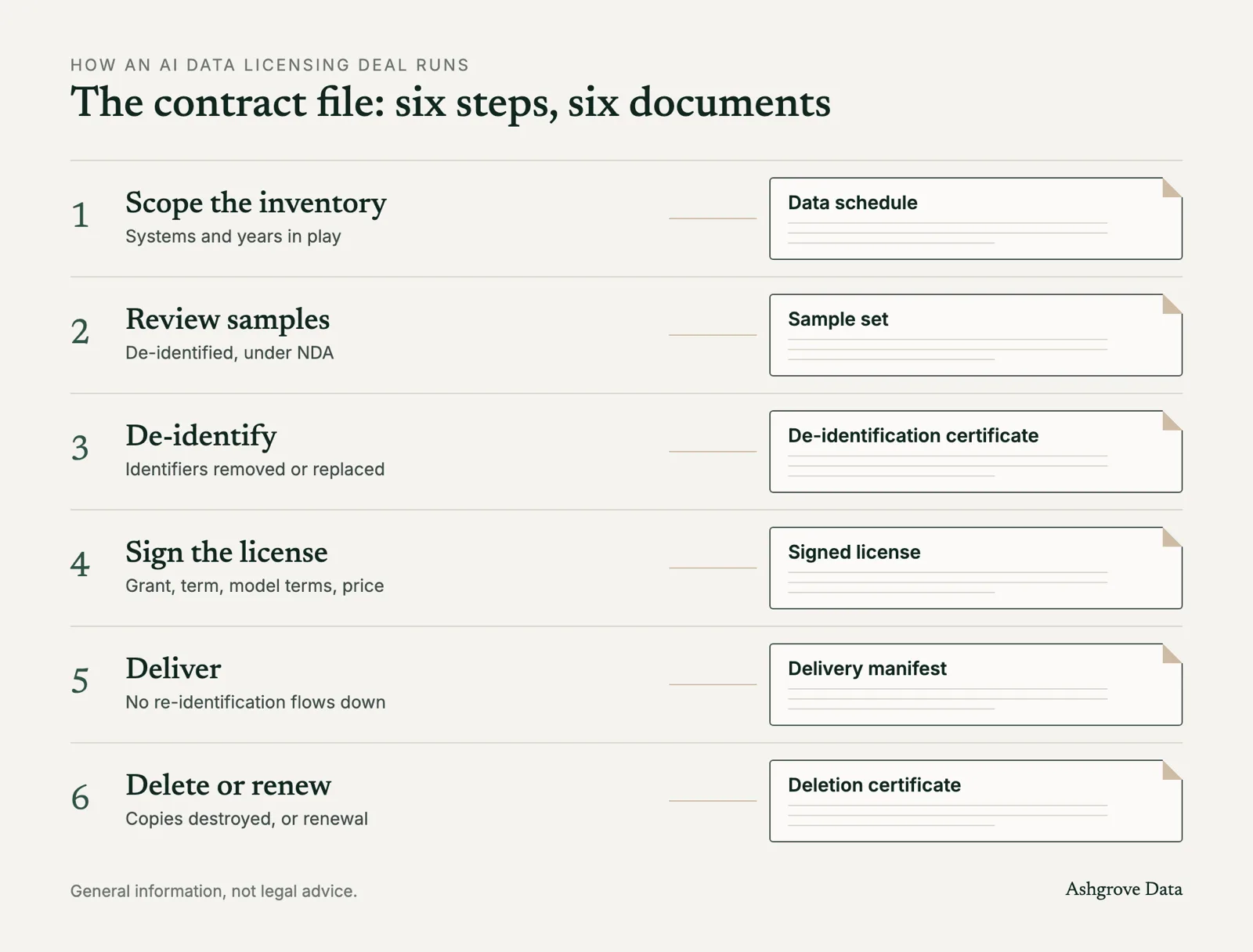
Every deal moves through six steps, and each one adds a document to the contract file.
1. Scope the inventory. Both sides settle which systems and years are covered, and that agreement becomes the data schedule. 2. Review samples. Under an NDA, the buyer reviews de-identified samples; a raw export is never on the table. 3. De-identify. Before anything ships, identifiers come out or get swapped. The Spirit Airlines sale still awaits court approval, and in that deal the agent Tonic.ai must certify each transfer to the court (The Next Web). Ashgrove swaps real names for consistent pseudonyms, so "Person 14" stays Person 14 across Slack, email and tickets. 4. Sign the license. The grant, term, model terms and price all get fixed here. 5. Deliver. The data ships with a manifest, and the no-re-identification duty binds anyone the buyer passes it to. 6. Delete or renew. When the term runs out, every copy is deleted against a certificate, or the license renews.
Which clauses decide what a data license is worth?
Eight clauses set most of a license's value; our study shows where published terms stay silent.
| Clause | Published default (43 documents) | What to ask for |
|---|---|---|
| Grant scope | 47% name AI training | List each use: training, fine-tuning, evaluation, RAG |
| Exclusivity | 56% say non-exclusive | Non-exclusive; price exclusivity separately |
| Term | Usually open-ended or silent | A fixed term with renewal |
| Deletion | 37% require it | Deletion within a set number of days, with a certificate |
| Trained models | 4 of 43 address them | An explicit survival or deletion rule |
| Re-identification | 21% bar it | A ban that flows down to recipients |
| Onward transfer | Most bar or limit redistribution | Named sublicensees only |
| Audit | 40% give one | Audit on reasonable notice |
Definitions count as well: under the AWS Data Subscription Agreement, "Derived Data" includes "models", and it belongs to the buyer (AWS).

We negotiate these clauses buyer by buyer and default to non-exclusive licenses (how Ashgrove Data works).
What happens to trained models when the license ends?
Absent contract language to the contrary, the buyer keeps the model: wiping the data leaves whatever the model learned intact, and pulling that knowledge back out can mean retraining (HHQ).
Published terms land in one of three camps. Opendatabay's seller agreement says termination obligates no one to "delete, retrain or disable any model" (Opendatabay). Reddit goes the other way and requires derived models to be deleted. Nothing in the other documents we read addresses this.
Regulators can force deletion either way: the FTC's 2021 Everalbum order made the company delete models built from users' photos (FTC). Settle this before signing: do models trained during the term survive, get retired, or carry on for an extra fee?
How are sellers paid under an AI data license?
Payment takes the form of a fixed fee, a recurring fee, a usage-based fee, a revenue share, or a mix. Media & the Machine tracked 44 publisher deals and found most followed the same template: a fixed upfront payment plus a usage-based payout (Media & the Machine).
| Model | How it works | Public example |
|---|---|---|
| Fixed fee | One payment for a defined dataset | Mercor pays by wire on delivery of the anonymized dataset (Mercor) |
| Recurring | Annual fee for continued access | Google pays Reddit about $60 million a year (The Decoder) |
| Usage-based | Per token, query or record | Rare in published data terms |
| Revenue share | A percentage of resale revenue | Pond5 pays contributors 20% on dataset sales (Pond5) |
For company records, a fixed fee is simplest, since you can't reliably meter usage inside a model. The company data value calculator gives you a starting figure.
Should an AI data license be exclusive?
In most cases, no. None of the 43 documents we reviewed hands out exclusivity by default; an exclusive license wipes out every other buyer for its term. Grant it only when the fee offsets what later buyers would pay, the scope is narrow, the term short, and unused rights revert to you. No public data yet quantifies the premium exclusivity commands in company-data deals.
Are there industry standards for AI data licensing?
Early, voluntary ones do exist. In September 2024, the Dataset Providers Alliance put out a position paper backing opt-in consent and market-based licensing (BigDATAwire). The Montreal Data License offers a common vocabulary for rights, and in November 2025 the European Commission signed off on voluntary model contractual terms for data sharing under the Data Act (European Commission). None carries binding force.
Frequently asked questions
Does a data license have to say "AI training" to allow it?
Not always. A broad grant may already cover it, but naming it avoids disputes. Name fine-tuning and evaluation too.
Who de-identifies the data, the seller or the buyer?
Either side, or a third party, per the contract. Include a re-identification ban, as 21% of published terms do.
Do open data licenses allow AI training?
Often, yes. CDLA-Permissive 2.0 imposes no limits on "Results," a term the license defines to cover machine learning models.
Get terms that protect you
Know what your data is worth before you negotiate: try the calculator or request a valuation.
Open the calculator