How to Sell Company Data to AI Labs: 33 Offers Compared
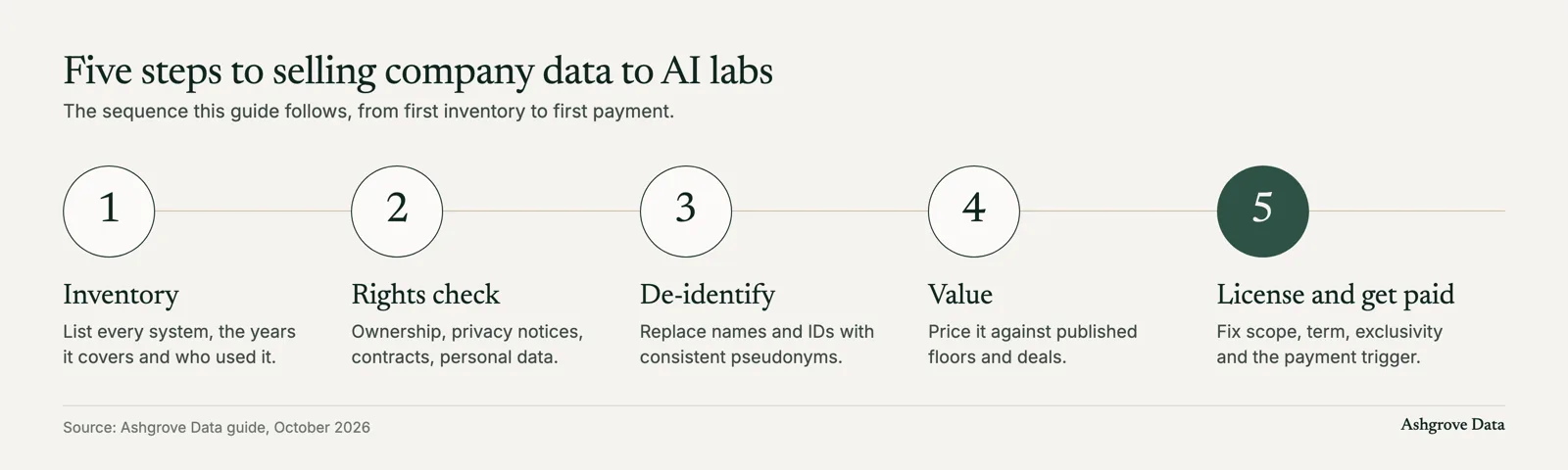
To sell company data to AI labs, license it instead of selling it outright: take stock of your systems, confirm you hold the rights, de-identify the records, value them, then sign with a lab, an AI data company or a broker. Across the 33 public offers we studied, most operating-company programs set their floor at $100,000.
Your Slack threads, tickets, docs and CRM history have buyers now. Comparing their offers is hard: one anchors on a codebase baseline, another on an airline's archive, most name no number. This guide covers the buyers, their prices and the five steps. Because Ashgrove Data is a broker, we excluded ourselves from the study.
What company data do AI labs buy?
AI labs pay for records of how work really gets done, ideally linked across tools. micro1, which has pledged $1 billion over 12 months for this data, lists SOPs, knowledge bases, internal documents, CRM data, project histories and QA processes (The Next Web).
Connections push prices higher. Sunset's CEO told Forbes that a Jira ticket tied to a code commit outvalues a standalone document, and records from healthcare and finance command a premium (Forbes).
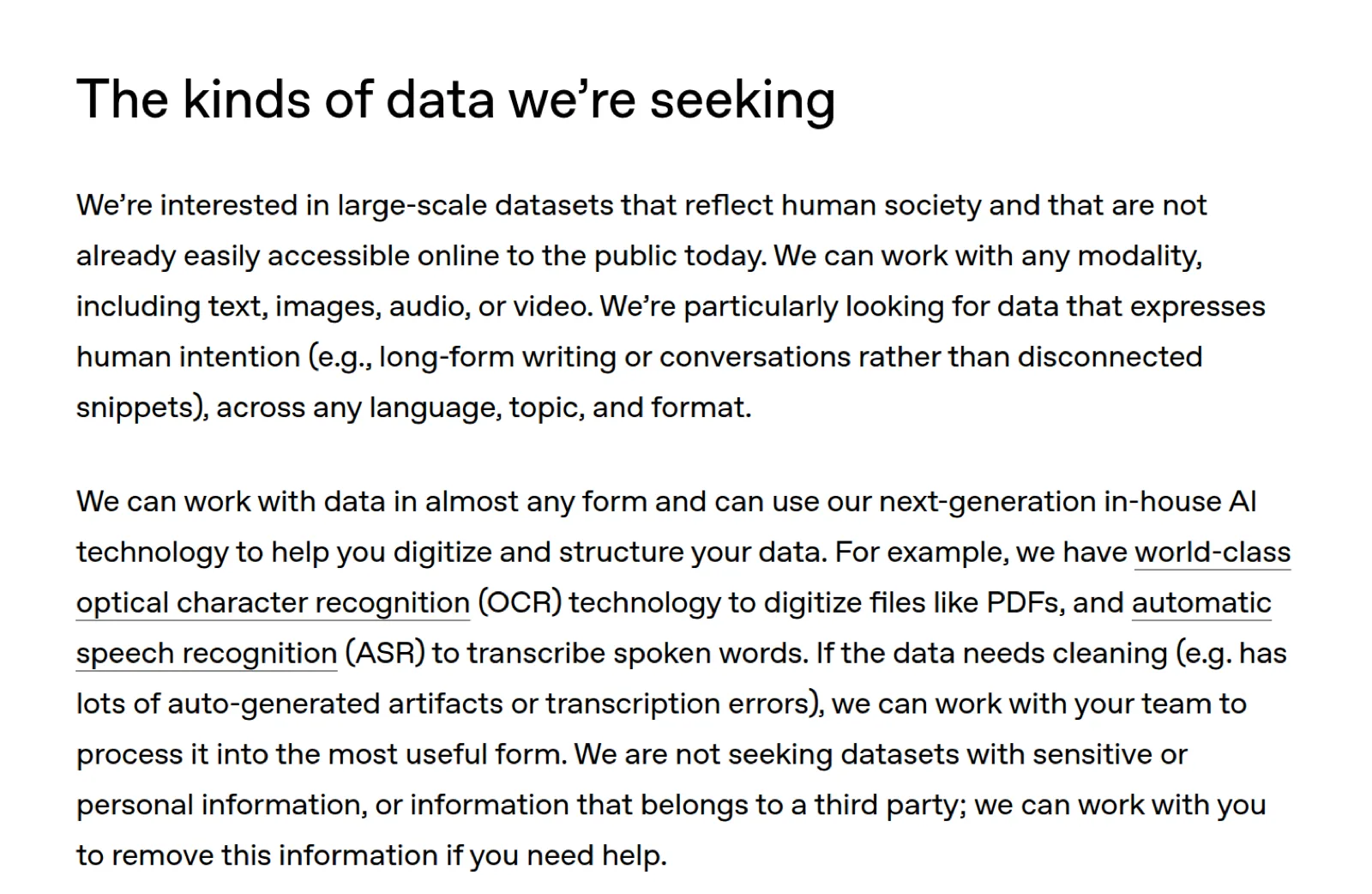
OpenAI, for its part, states it is not looking for datasets containing sensitive or personal information, or information that belongs to a third party (OpenAI).
Who buys company data for AI training?
Five distinct buyer types purchase company data; just two of the 24 routes we found involve an AI lab buying directly.
| Route | Examples | Who it fits |
|---|---|---|
| Direct lab program | OpenAI Data Partnerships, Google Content Offer Pilot | Owners of large datasets that are hard to find online, such as code repositories |
| AI data company | micro1, Mode, Turing Lazarus, Mercor, Centific | Operating companies with documented workflows; Turing and Centific also take winding-down companies |
| Broker or agent | Troveo, Red Deer Data, Databounties, Miro Advisory | Companies that want several buyers to bid |
| Wind-down platform | SimpleClosure, Sunset | Startups that are closing |
| Data marketplace | DataVendor, Defined.ai, AWS Data Exchange | Packaged datasets and codebases |
Your situation decides which route fits:
- Closing down: a wind-down platform, or Turing, Troveo or Centific. Just 25% of routes say they accept companies that are closing.
- Operating, with written processes: go with micro1 or Mode.
- One valuable codebase: look at DataVendor or Google's pilot.
- You want competing offers: work with a broker on a non-exclusive license, the way Ashgrove Data operates.
How much do AI labs pay for company data? Our study of 33 public offers
For a whole operating company, published floors sit at $100,000; across the five deals with exact public figures, the median lands at $500,000.
Our method. Between October 11 and 12, 2026, we coded 33 public offers: 24 buyer routes and 9 reported deals, located through the sources ChatGPT and Google's AI Overview cite on this question, the top 10 search results and targeted searches. For each one we pulled up the route's own page and logged the price, minimum company size, ownership terms, who handles de-identification and any stated timeline. Ashgrove Data and publisher content licenses were left out. Self-reported deals are labelled as such, and nobody audits them.
What we found:
- Most routes keep pricing quiet. Only 10 of 24 routes (42%) put a dollar figure in public, and neither direct lab program publishes one.
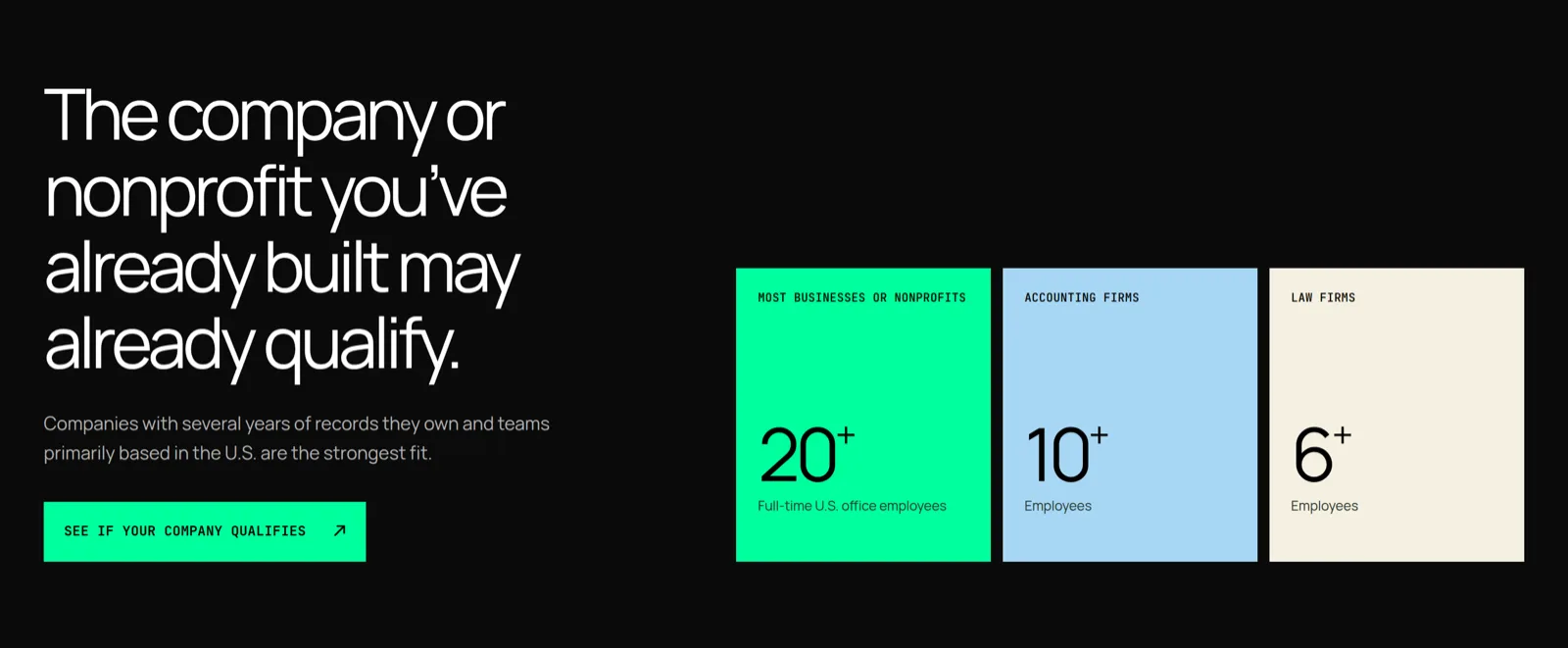
- Few routes set a size floor. Just 2 of 24 (8%) state a minimum headcount: micro1 requires 30+ employees, Mode asks for 20+ full-time US office staff.
- Floors bunch up at $100,000. 4 of the 5 operating-company programs peg their published minimum there, while published ceilings span $1 million to $5 million.
- You typically keep ownership. In 15 of 24 routes (63%) the buyer licenses your data or purchases a copy while the originals stay with you; 10 of the 24 say they de-identify the data on their end.
| Seller profile | Price | Evidence type |
|---|---|---|
| Single startup codebase | $5,000 baseline | Published (DataVendor) |
| Closed startup's archive | $10,000 to $100,000 | Reported, nearly 100 sales (Forbes) |
| cielo24, 13-year archive | "Hundreds of thousands of dollars" | Reported by the former CEO (Forbes) |
| Operating company, program floor | $100,000 | Published by 4 of 5 programs |
| Five deals with exact figures | $280,000 to $1.2 million (median $500,000) | Self-reported by micro1 and Red Deer Data |
| Spirit Airlines' archive | $7.5 million backup bid, $10 million agreed, $12.5 million proposal | Bankruptcy court, pending approval (Fortune) |
Your takeaway. Get a written figure from every buyer, and pin down who pays for de-identification. If your operating company holds years of records, any offer below $100,000 falls short of most published floors.
Step 1: How do you inventory company data for a sale?
Build a one-page data brief naming every system, the years it spans, its users, and what must not leave.
| System | Years covered | Users | Export format | Personal or customer data? | Contract limits |
|---|---|---|---|---|---|
| Slack (example) | 2018 to 2026 | 60 | JSON export | Yes: names, DMs | Check Slack terms |
| Jira (example) | 2019 to 2026 | 35 | CSV, attachments | Some | None known |
| HubSpot (example) | 2020 to 2026 | 12 | CSV | Yes: customers | Customer contracts |
Cancel nothing until the exports are done. Some operational history may become unavailable after applications have been decommissioned and their licenses expire, Centific warns (Centific).
Step 2: How do you confirm you have the rights to sell?
Before any buyer sees a sample, verify four things: ownership, the privacy notices in effect when the data was collected, customer and vendor contracts, and personal data. Vendor terms count as well. Slack's API terms prohibit apps offered outside your organization from training a large language model on API data or bulk exporting messages without an additional agreement (Slack). Each of the four checks is spelled out in the Ashgrove rights check. This is general information rather than legal advice.
Step 3: How is company data de-identified before a sale?
Before delivery, names, emails, phone numbers and account IDs are stripped out or swapped for consistent pseudonyms. Because the swap stays consistent, "Person 14" is the same individual across Slack, email and tickets, so the workflow remains easy to follow.
Free text is where this gets hard: find-and-replace won't catch "the new hire from our Austin office". In the Spirit Airlines sale, the buyer carries every de-identification cost with no cut to the price (The Next Web), and the flight attendants' union objected anyway, arguing that linked records could still identify people (ch-aviation).
Step 4: How do you value company data before talking to buyers?
Start from published floors and deals, then adjust for headcount, history, connected systems and documentation. The free company data value calculator runs that comparison and lays out every factor in the final figure.
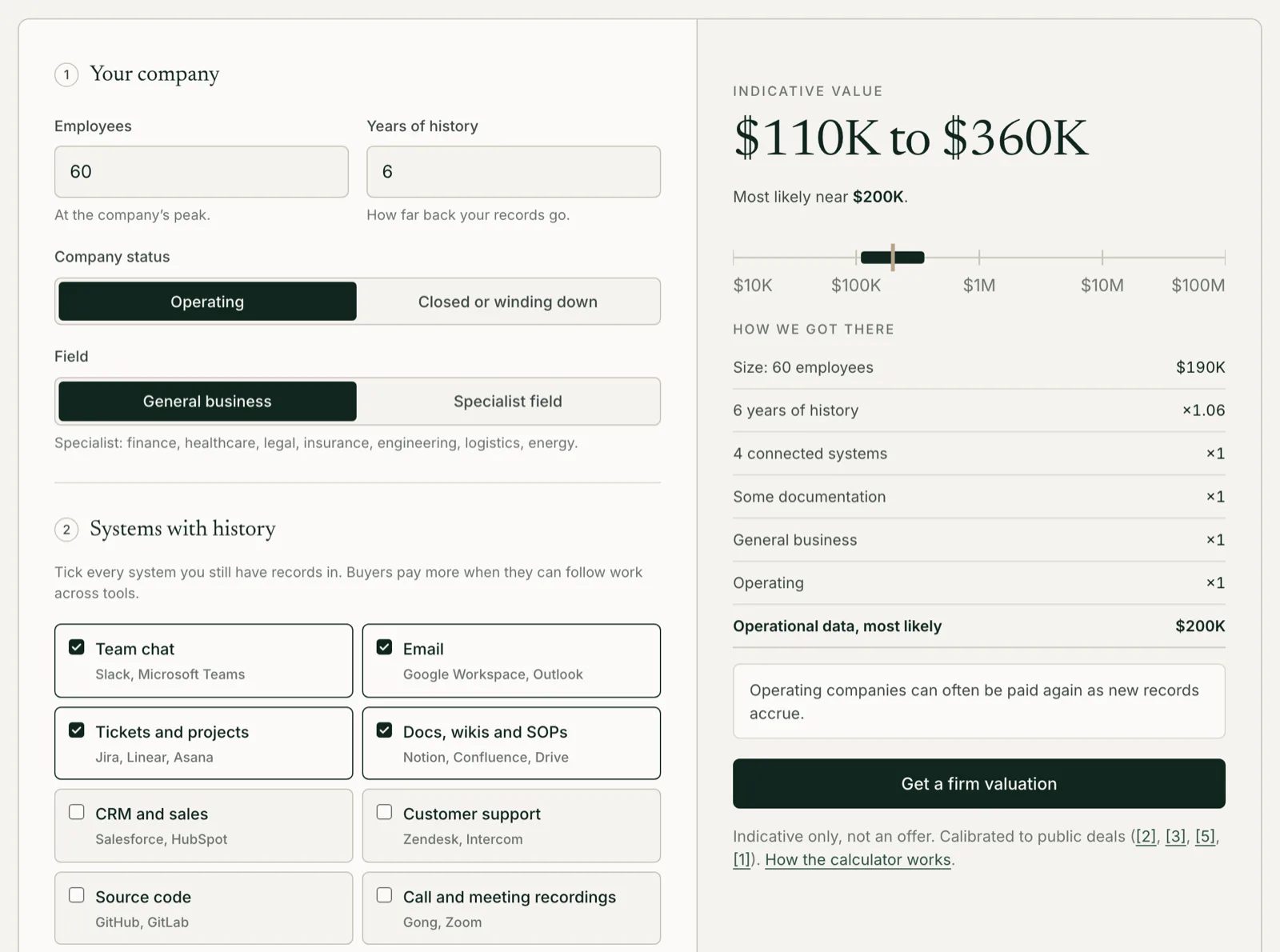
In our model, a company 10 times larger carries about 4.5 times the value. Run your own numbers before the first offer shows up.
Step 5: How do you license the data and get paid?
Lock the scope, term, exclusivity, de-identification standard and payment trigger into a signed license. Those triggers aren't uniform: Mercor wires payment once the anonymized dataset reaches the buyer (Mercor); Turing pays a single sum with no recurring commitment (Turing). For the clauses that set the price, read how AI data licensing works.
How long does it take to sell company data?
Just 17% of the routes we coded give any deal timeline, which ranges from one day to twelve weeks; court-supervised sales run for months.
| Route | Stated duration | Source |
|---|---|---|
| micro1 | One $585,000 deal closed in a day; average sales cycle 9+ days | CEO on X, October 2026 |
| Red Deer Data | 2 days to 2 weeks from bid to wire; listed deals paid in 5 to 9 days | Red Deer Data |
| Turing Lazarus | Call within one business day; sampling usually within a week | Turing |
| Databounties | 4 to 12 weeks from first call to signed licence | Databounties |
| Spirit Airlines (bankruptcy) | Agreed in August 2026; hearing postponed to 6 November 2026 | Miami Herald via Yahoo |
What mistakes should you avoid when selling company data?
Avoid these five mistakes:
- Cancelling tools before exporting. Pull a full export from every system while its subscription is still active.
- Taking one buyer's number. In the Spirit auction, Google opened at $5 million, then raised its bid once Mercor competed (The Next Web).
- Sending raw exports. Share the data brief and de-identified samples under NDA, never a raw database dump.
- Granting exclusivity cheaply. That one concession removes every future buyer.
- Skipping the rights check. A single customer contract with a confidentiality clause can stop a deal late.
Frequently asked questions
Can I sell my company's data directly to OpenAI?
OpenAI Data Partnerships accepts applications and looks for large datasets that aren't readily available online. It lists no pricing, so weigh any offer against what intermediaries quote.
Can a small company sell its data?
Yes. Mode accepts law firms from 6 employees and accounting firms from 10 (Mode), and most routes publish no size floor at all.
Do I give up ownership when I sell data to an AI lab?
Not if you license it, which is what 15 of the 24 routes offer. Turing's Lazarus is the one route in our study that only buys outright.
What can a closed startup's data sell for?
Wind-down platforms like SimpleClosure generally pay $10,000 to $100,000 per company, while cielo24's 13-year archive sold for hundreds of thousands of dollars.
Is it legal to sell company data to AI labs?
Typically yes, as long as the company owns the records and its notices and contracts permit the sale. Read whether selling company data is legal; this is general information, not legal advice.
Find out what your data is worth
Enter your headcount, years and systems in the company data value calculator, or request a valuation.
Open the calculator